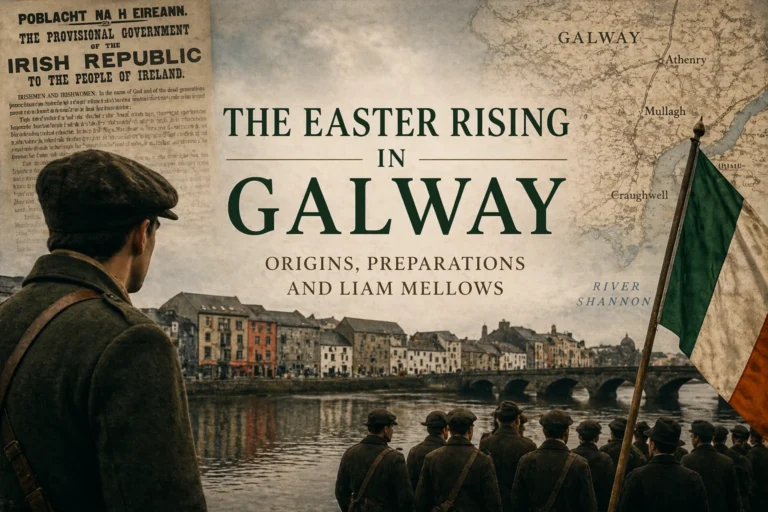
So… what was the Easter Rising?
The Easter Rising marked the beginning of a new era in Irish nationalism. In April 1916, a relatively small group, many of them young and driven by idealism, rose up against British rule with the aim of establishing an Irish Republic. From the outset, the rebellion was unlikely to succeed.
One important point is that most of the fighting was concentrated in Dublin, and outside the capital the Rising had limited impact. However, County Galway stood out as one of the few areas where any significant activity took place, even if the scale of the rebellion there remained small.
The Origins of the Easter Rising
The Easter Rising was not simply an attempt to stage a rebellion; it was also a deliberate effort to make a statement. They wanted not only to proclaim an Irish Republic, but to awaken a sense of national pride that they believed had been lost. So, although the leaders hoped for success, they were equally motivated by the desire to make a powerful symbolic gesture, one that would restore what they saw as Ireland’s damaged honour and challenge what they viewed as a passive acceptance of British rule.
A new sense of Irish identity

These young men were shaped by a growing wave of nationalism that emphasised a distinctly Irish culture and identity. This sense of national awareness was driven largely by organisations such as the Gaelic League and the Gaelic Athletic Association, along with the cultural influence of the Abbey Theatre and figures like W. B. Yeats.
Many leading members of these movements were also involved in the Irish Republican Brotherhood (IRB), which played a key role in turning cultural nationalism into political action. This growing sense of identity was soon channelled into organisation and preparation when Eoin MacNeill proposed the formation of a body of Irish Volunteers in October 1913, modelled on the Ulster Volunteers.
The creation of the Volunteers
The political situation began to shift in 1913. Eoin MacNeill proposed the formation of a volunteer force in response to the Ulster Volunteers. This idea quickly gained traction. On November 25, 1913, the Irish Volunteers were officially founded at a meeting in Dublin’s Rotunda Hall, organised by the IRB and MacNeill was appointed as President. At this stage, most members did not expect an immediate rebellion. Many believed the Volunteers would only be used, if necessary, particularly if unionists attempted to block Home Rule by force.
The movement reaches Galway
The movement spread rapidly across the country, and County Galway was quick to respond. Within weeks of the Dublin meeting, branches of the Volunteers had been established in Galway. The first was formed in Galway town on December 12, 1913, following a large public meeting addressed by figures such as Roger Casement, Patrick Pearse, and MacNeill himself. One account of this meeting captures both the enthusiasm and the confusion of the time. During his speech, Casement warned that Ireland must be prepared in case of a German invasion. However, many in the audience misunderstood his words and responded with loud cheers, interpreting them as support for Germany rather than a call to resist it. Despite this misunderstanding, the meeting was a major success and marked Casement’s first significant public appearance in Ireland.
The impact was immediate. Hundreds of men joined the Volunteers that night, and in the days that followed, new companies were quickly established in towns such as Headford and Tuam.
Then came the split
The Volunteer movement soon split following the outbreak of World War I. At that moment, John Redmond, leader of the Irish Parliamentary Party, urged Irishmen to enlist in the British Army and support the war effort. The majority followed his call and became known as the National Volunteers, while a smaller group broke away and retained the name Irish Volunteers. This smaller group quickly reorganised, forming a provisional committee in Dublin to rebuild the movement across the country and Liam Mellows was the person decided to go to Galway.
Liam Mellows and the reorganisation in Galway
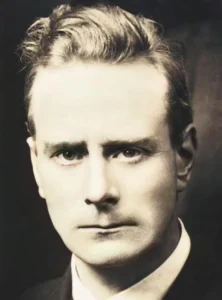
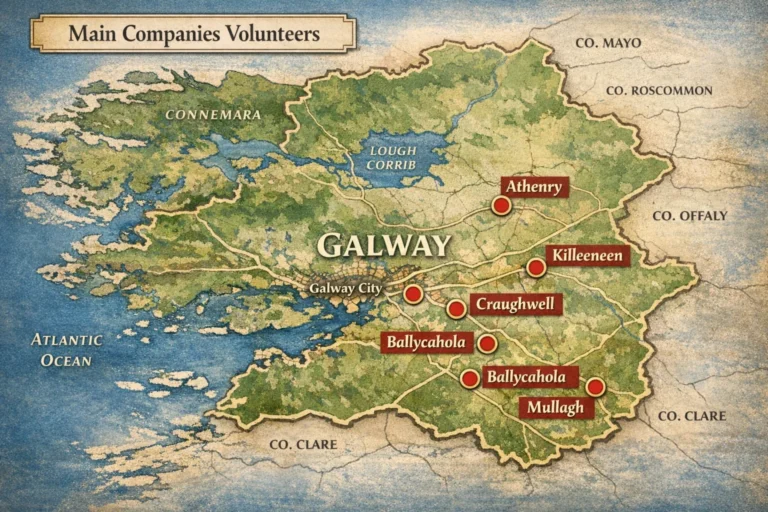
Athenry had already been a centre of earlier land reform movements, and this background helped create a strong foundation for organisation in the area. When Liam Mellows arrived in Galway in late October 1914, he set up his headquarters in Athenry, an area where the new movement already had strong support. A key part of his work was also training a core group of instructors who could spread the movement further. He was supported by a network of local men in Athenry, including John Cleary, Frank Hynes, Stephen Jordan, Jim Barrett, and Seán Broderick, with Larry Lardner acting as Commanding Officer. Beyond Athenry, support extended across south Galway, with figures such as Michael Fleming and his sons in Clarenbridge, Eamonn Corbett and others in Killeeneen, Pádraic Fahy in Ballycahola, and Pat Callanan and Tom Kenny near Craughwell.
Mellows also secured the cooperation of local clergy, small farmers, and schoolteachers. This support would later prove vital, as many of them helped to shelter Volunteers after the failure of the Rising.
By June 1915, believing that south Galway was well organised, Mellows turned his attention to the east. He initially set up headquarters in Mullagh, but struggled to find the same level of support he had encountered in Athenry. As a result, he relocated again, eventually establishing a new base at Kynoch’s Fort in Ballycahalan, near Gort.
Arrest, imprisonment, and growing support
On July 30, 1915, Mellows was arrested and sentenced to three months in prison. He was one of many Volunteers detained at the time. Mellows was only one of many Volunteers detained at the time. Rather than weakening the movement, these arrests had the opposite effect, increasing sympathy for the Volunteers and gradually shifting support away from Redmond’s followers.
When Mellows returned to Galway in November 1915, the movement was stronger and more determined. By December, the remaining imprisoned Volunteers had also been released.
Setting the stage
By early 1916, the foundations for rebellion in Galway were firmly in place. What began as a cultural revival had developed into an organised revolutionary movement, one that, although small in scale, was ready to take part in the events of Easter Week.
Official Publications
PRO, CO 904, London (Available on microfilm in the James Hardiman Library)
James Hardiman Library
Brian Cusack Papers, Pol. 16.
Newspapers
The Freeman’s Journal (1916-1922)
Bibliography
Coogan, Tim Pat, Michael Collins: A biography. (London: Weidenfeld and Nicholson, 1998).
Greaves, C. Desmond, ‘Liam Mellows’ in The Capuchin Annual, (1972).
Laffan, Michael, The Resurrection of Ireland: The Sinn Féin Party 1916-1923. (Cambridge University Press, 1999)
McMahon, Timothy G. (ed.), Pádraig Ó Fathaigh’s. War of Independence. Recollections of a Galway Gaelic Leaguer. (Cork University Press, 2000).