Planning the Rising
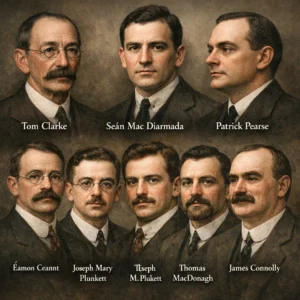
Back in May 1915, the Irish Republican Brotherhood Military Committee, composed by Tom Clarke, Seán Mac Diarmada, Patrick Pearse, Éamon Ceannt, Joseph Mary Plunkett, Thomas MacDonagh, and James Connolly, began planning an insurrection against British rule. Their strategy was shaped by World War I as they saw the war as a unique opportunity. If Britain emerged quickly victorious, Irish revolutionary efforts risked appearing ineffective. Initially, a rising was planned for September 1915, but delays pushed preparations into 1916.
Preparing for Rebellion in Galway
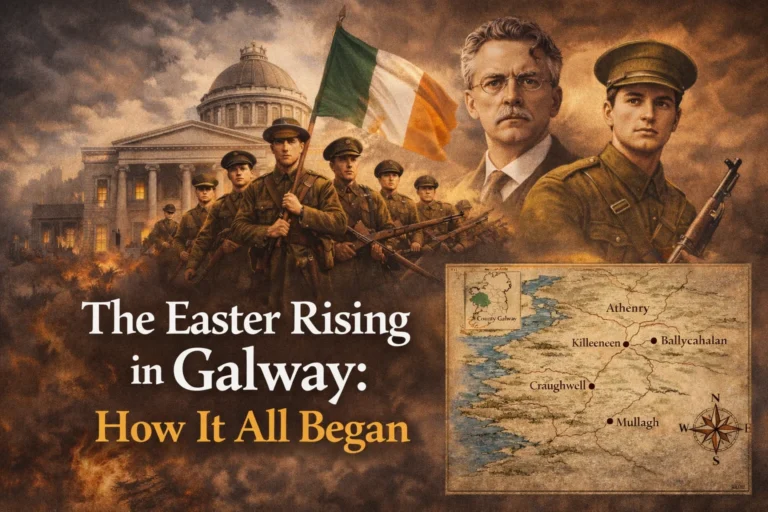
Although Dublin remained the focal point, preparations intensified in County Galway from late 1915 onward. That was the moment that local Volunteers faced a critical problem: lack of arms. As a result, they improvised.
Shortly before Christmas 1915… I was wanted home to make pike heads.
Working secretly in his father’s forge in Brierhill, Michael Newell, a member of the Castlegar Company, produced between fifty and sixty pike heads. As firearms were scarce and highly valued, these improvised weapons became essential to the Volunteers’ plans. At the same time, the work had to remain hidden, as the Royal Irish Constabulary maintained constant surveillance; therefore, sentries were posted nearby to watch the roads and give warning at the first sign of danger. Despite these risks, preparations continued steadily and with quiet determination.
Mellows and the Galway Strategy
Leadership in Galway fell to Liam Mellows, as discussed in a previous post, who aimed to disrupt British forces west of the River Shannon while Dublin remained the main theatre of operations. However, these plans nearly collapsed when Mellows was arrested on 20 March 1916 and deported to England. He later escaped and returned to Galway just before the Rising began. During his absence, key figures such as Larry Lardner and George Nicholls took charge of final preparations for the rebellion.
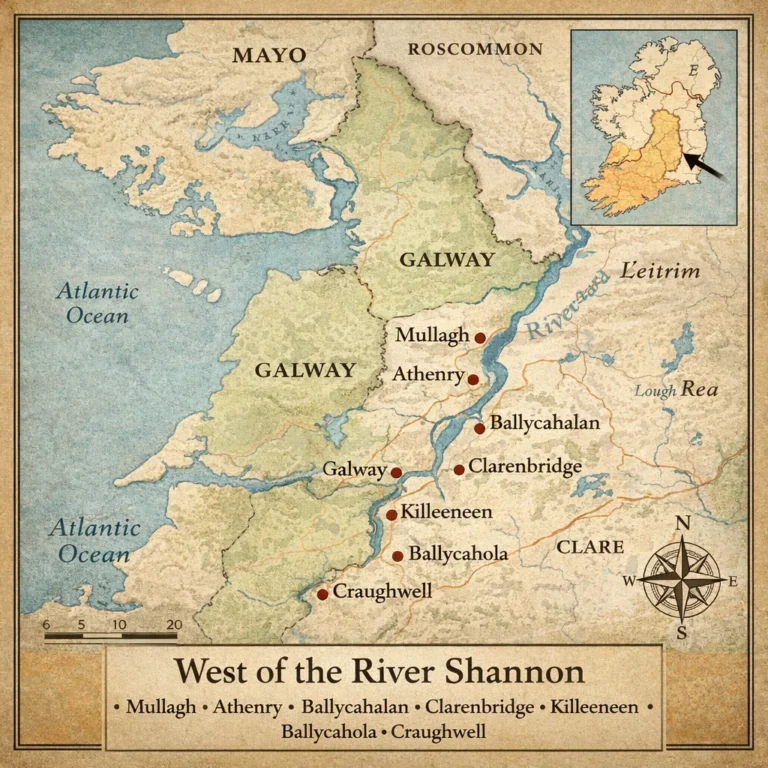
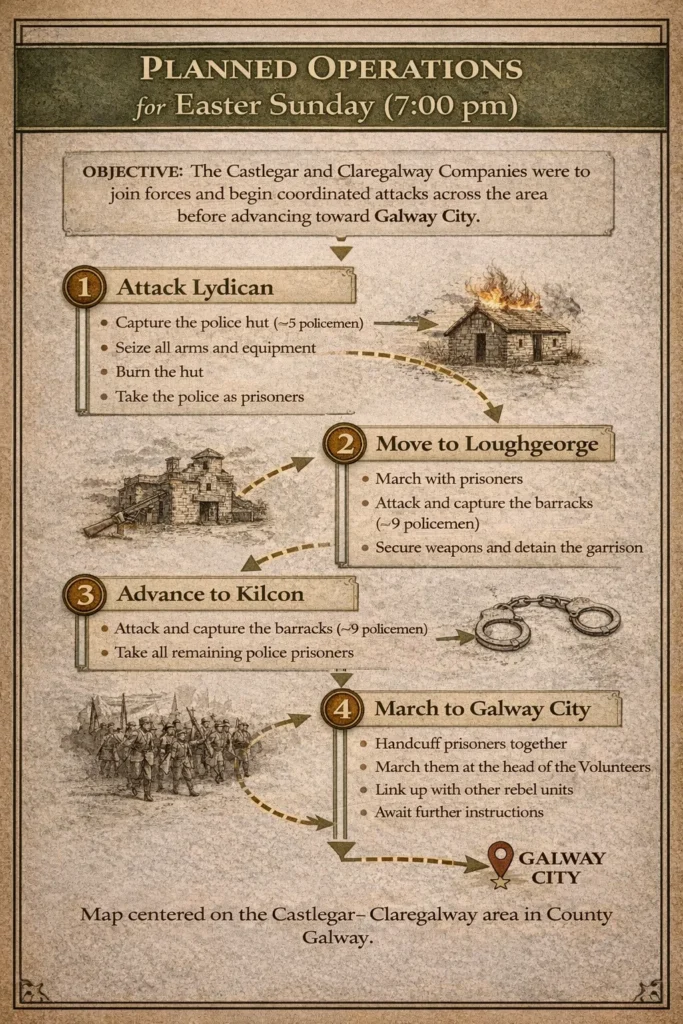
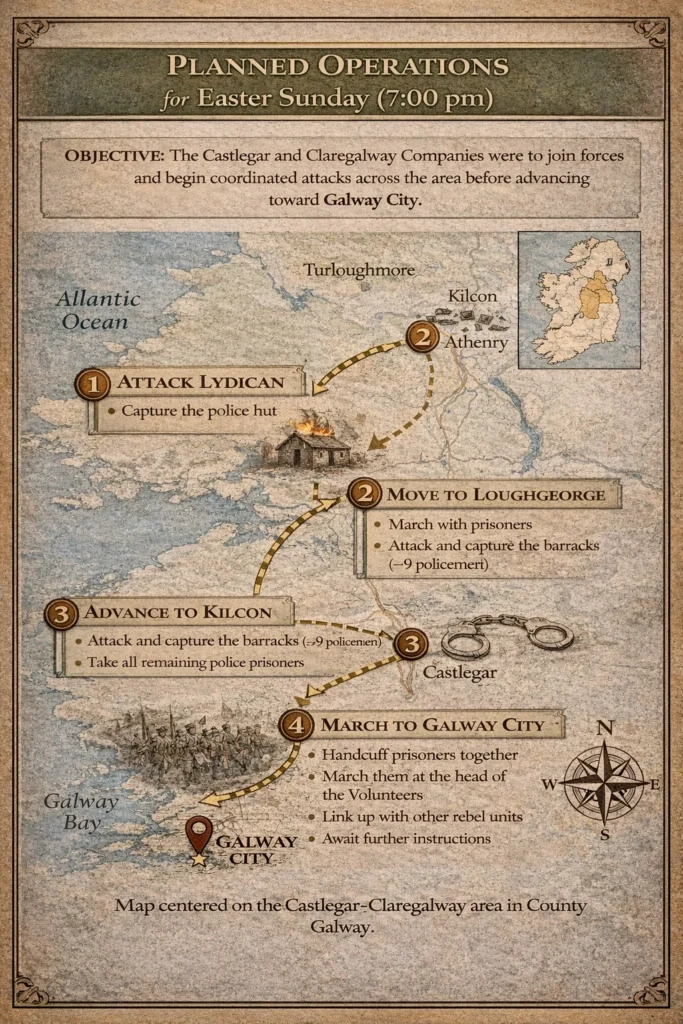
On Thursday April 20 night 1916, Brian Molloy (Cúil Each-Cahir), Tom Ruane (Lydican) and Newell, met George Nichols (City Enginer) by appointment at Oranmore railway station. Nichols came from Dublin by train which arrived at Oranmore at 12.00 midnights. He gave them the instructions to begin the Rising, which had to star on Sunday April 23, Eastern Sunday, afternoon:
Confusion and Countermanding Orders
On Easter Sunday, 23rd of April, the Castlegar Company, under the command of Brian Molloy, mobilised with around sixty men. Of these, between twenty and twenty-five were armed with shotguns, while the remainder carried the pikes forged by Newell. They marched as instructed to Carnmore Cross-roads, where, at approximately 6:00 pm, they linked up with the Claregalway Company, led by Nicholas Kyne. Once united, both companies were ordered to ‘stand-to’ and await further instructions. However, after only a short time, word arrived that the planned operations had been cancelled.
This sudden cancellation was the result of deep divisions within the Volunteer leadership. Although the Easter Rising had been carefully planned by the Irish Republican Brotherhood, the operation relied on the combined participation of the Irish Volunteers and the Irish Citizen Army. Eoin MacNeill, Chief of Staff of the Volunteers, only became fully aware of the plans in the days before the Rising. According to historian Ryle Dwyer, MacNeill initially attempted to cancel the operation. However, IRB leaders persuaded him to delay his decision, arguing that the British were preparing to arrest Volunteer leaders and that Roger Casement had secured German support in the form of arms.
Everything changed on Easter Sunday, when Casement was arrested and the expected arms shipment was seized. For MacNeill, this removed any justification for proceeding. He immediately issued a countermanding order, effectively cancelling the Rising across the country. In Galway, the impact was immediate: Volunteers, as it was appointed, were sent home, while Liam Mellows and other local leaders remained in Athenry, waiting for further instructions that would soon alter the course of events once again.
The Rising in Galway
After meeting on 23 April, the Military Council decided to begin the Rising the following morning. When the new orders arrived in Athenry on the night of the 24th, Liam Mellows quickly sent out messengers to mobilise the different companies.
Tuesday 24 of April
While Liam Mellows planned to move south of the River Shannon with the objective of capturing Portumna and, if possible, advancing towards Dublin; the various Volunteer companies in Galway were assigned a more immediate aim: to secure the area surrounding Galway City.
As part of this plan, the Castlegar Company advanced towards Oranmore, where they were to join forces with the Oranmore, Clarinbridge, and Maree Companies. It was along the route between Clarinbridge and Oranmore that the most significant events of Tuesday unfolded.
A large force of Volunteers carried out coordinated acts of sabotage:
- The railway line at Oranmore was cut
- The signal cabin was damaged
- Telephone instruments were destroyed
- Telegraph poles were cut down
In addition, a large hole was made in the bridge at Oranmore village, with the keystone removed, rendering it unusable. Stone barricades were erected on the roads approaching Clarinbridge, and all passing vehicles were stopped and seized.
The next step was to attacked the Barracks of these towns.
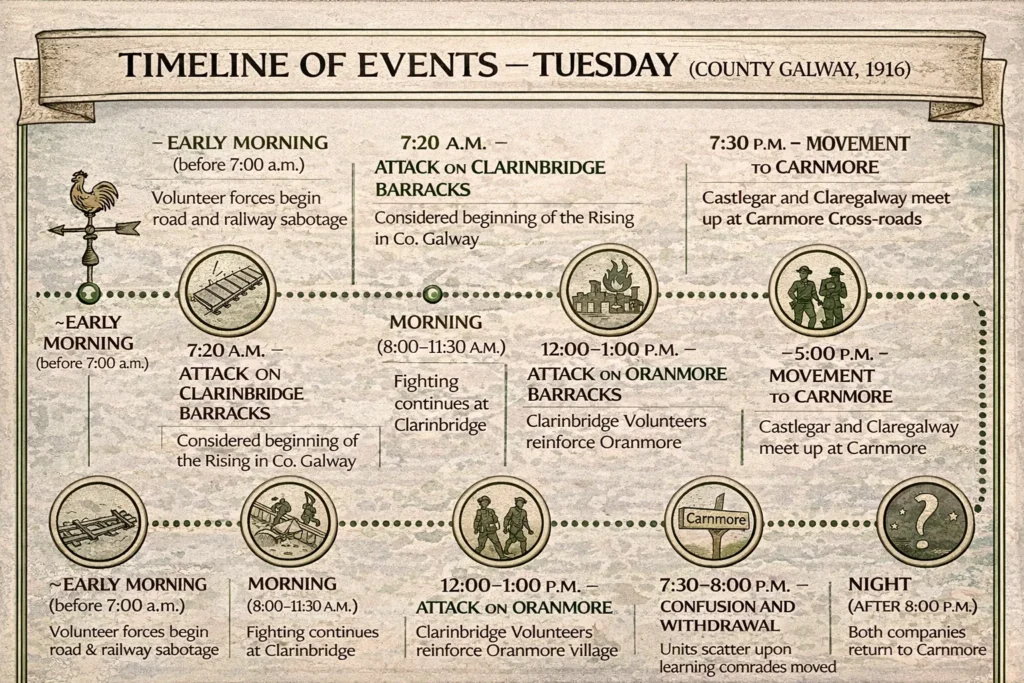
The first was directed to Clarenbridge Barracks, locate over nine miles from Galway City, it was considered the beginning of the Rising in Co. Galway. The assault began at approximately 7:20 a.m. where around 100 Volunteers took part, with numbers increasing as the engagement continued. It was defended by five police officers who were twice called upon to surrender, with threats that the building would be blown up, but they held their position.
Following the engagement at Clarinbridge, the Clarinbridge Company moved to Oranmore, where they joined forces with the local Volunteers. Together, they launched the secod attack, the one to Oranmore Barracks wich took place between midday and 1:00 p.m. The barracks, defended by four policemen, held out until approximately 7:30 p.m., when reinforcements from Galway—comprising police and military—arrived. At that point, the Volunteers withdrew and retreated towards Athenry in commandeered vehicles.
Meanwhile, Brian Molloy and Pat Callinan had set out to mobilise the Moycullen Company. Upon their return, at around 5:00 p.m. on Tuesday, they marched to Carnmore Cross-roads, where they once again linked up with the Claregalway Company.
Later, between 7:30 and 8:00 p.m., the Castlegar Company—having proceeded towards Oranmore—learned that the units they were to join had already moved on to Athenry. In response, Captain Molloy dispatched Lieutenant Tom Newell and a Volunteer from the Claregalway Company to seek instructions from Mellows.
Both companies then withdrew to Carnmore. The Claregalway Company billeted in farmhouses and barns, while the Castlegar Company took up position in Kiltullagh. Sentries were posted on all surrounding roads as they awaited further developments.
Wednesday 25 of April:
The most significant clash took place at Carnmore on Wednesday morning, at 6:00 a.m. A police reconnaissance unit advancing in motor cars was ambushed by Volunteers. During the exchange:
- Constable Patrick Whelan was killed
- Several officers were wounded
- The police were forced to retreat
Later that morning, between 10:00 and 11:00 a.m., as the Volunteers moved towards Moyode Castle, they came under fire from the Royal Irish Constabulary at a railway bridge. The police interpreted this movement as a possible attempt to advance on Galway City. However, with naval forces now present in the city, the Volunteers abandoned any such plan and withdrew.
While the rebels controlled the areas surrounding Galway City, British authority within the city was rapidly reasserted. Troops and marines were landed at the port, and a loyal corps of Volunteers was organised to assist in maintaining order. In response to the unrest, strict measures were introduced under the Defence of the Realm Act, most notably the imposition of a curfew. At 3:30 p.m., a typewritten notice issued by the Commander of the Royal Navy was displayed on the windows of the Post Office, formally ordering all civilians to remain indoors from 5 p.m. until the following morning. This proclamation illustrates how quickly military control was established in Galway, as the authorities sought to restrict movement, prevent coordination among rebels, and secure the city against further escalation.
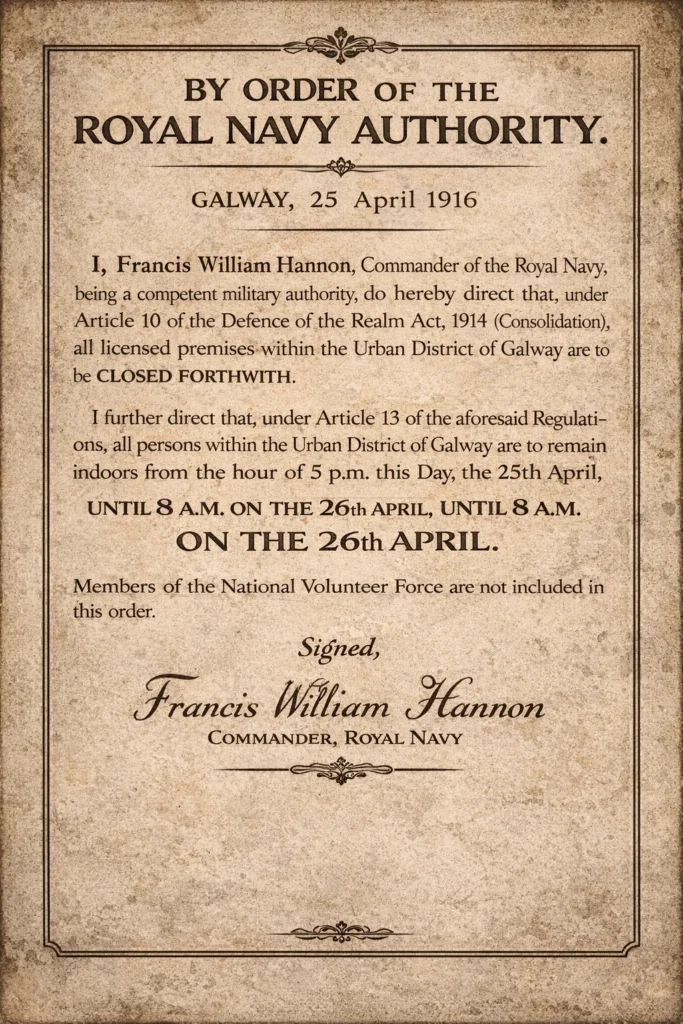
By afternoon the first arrests in Galway were made.
Thrusday and Friday, 26 and 27 of April
By Thursday, the position of the Volunteers in Galway had become increasingly precarious. The Royal Irish Constabulary was reinforced when a war sloop landed one hundred troops in Galway City, strengthening British control of the area. On the following day, military reconnaissance parties were sent out towards Athenry, where it was reported that the rebels were operating only a few miles away. Under mounting pressure, the Volunteers moved eastward, where, according to reports, a local priest advised them to disperse and return home.
Later that day, in the afternoon, the Volunteers marched by back roads towards Lime Park, arriving close to midnight after days of exhaustion and uncertainty. It was there, in the darkness, that the final decision, to disband, was made.
Aftermath
The Easter Rising in Galway ended in failure.
- Galway City was never captured
- The Shannon was not crossed
- Rebel control remained limited and temporary
In the aftermath:
- Around 400 people were arrested
- Leaders and participants were imprisoned
- Liam Mellows escaped through Connemara
Conclusion
Although unsuccessful militarily, the Rising in Galway formed part of a wider national rebellion that reshaped Irish history. The events demonstrated both the determination of local Volunteers and the severe limitations they faced—particularly in arms, coordination, and communication.
The legacy of 1916 would ultimately transform public opinion and pave the way toward Irish independence.